
2026-08-01 · Molecular Plant
ZLab launches PlantPTM, an AI platform for plant protein post-translational modification prediction
PlantPTM integrates protein language models with multi-view features across six plant species and nine PTM types, providing a scalable AI platform for functional proteomics and molecular breeding.
A ZLab collaboration led by Zhen Chen, Gensheng Dou, and Junzhou Li has published “PlantPTM: A deep learning framework integrating protein language models with multi-view features for predicting diverse post-translational modification sites in plants” in Molecular Plant. The study introduces a unified deep-learning framework spanning multiple plant species and modification types.
Protein post-translational modifications regulate conformation, activity, stability, and subcellular localization, with essential roles in plant development, stress response, and signalling. The team integrated public databases and literature to assemble 657,623 PTM sites across 211,535 proteins, covering Arabidopsis, rice, maize, wheat, soybean, and tomato and nine modification types.
PlantPTM uses a three-stage architecture for encoding, feature fusion, and prediction. Parallel CNN, BiGRU, ProtBert, and handcrafted-feature encoders capture local sequence patterns, long-range dependencies, protein-language representations, PSSMs, and one-hot features before self-attention integrates the complementary views.
Across nine independent test tasks, PlantPTM achieved a mean AUROC of 0.8640, reaching 0.9699 for N-glycosylation. Against 25 existing predictors, AUROC improved by 2.90%–19.08%, with a mean gain of 15.46%. Leave-one-species-out evaluation and independent rice mass-spectrometry datasets further supported cross-species generalization and experimental relevance.
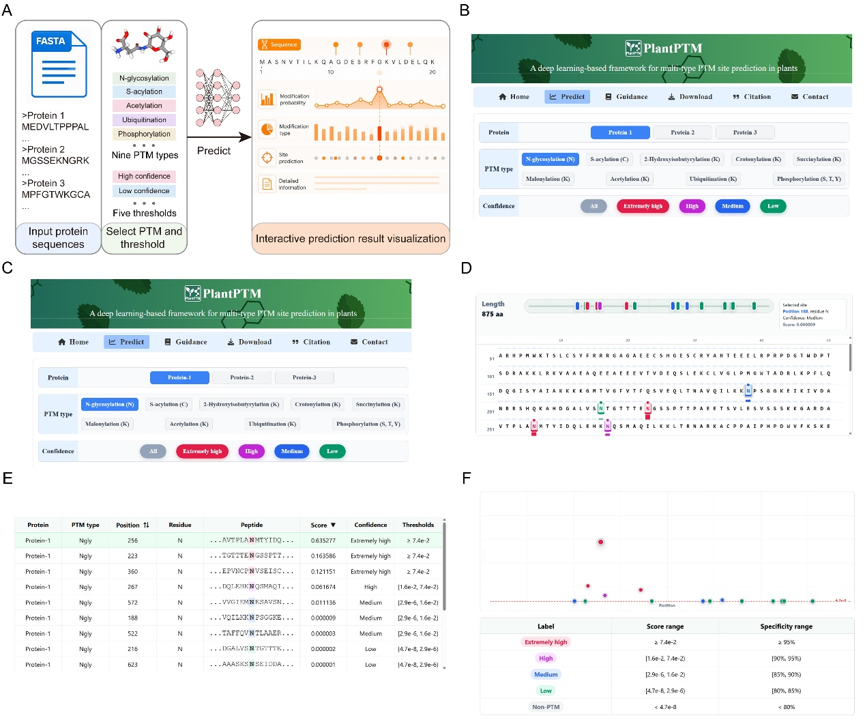
The team also released a free PlantPTM web service for batch prediction, confidence-based site ranking, and visualization. Future development will expand the supported PTM types and species and integrate protein structure and functional annotations for crop design, molecular breeding, and plant synthetic biology.