
2026-09-24 · Molecular Cell
ZLab develops unZipro, an AI-driven strategy for efficient protein evolution
ZLab, together with the teams of Prof. Xiang Ji, Researcher Daowen Wang, and Prof. Jiangning Song at Monash University, has published a study in Molecular Cell introducing unZipro, an AI-driven strategy for efficient protein evolution.
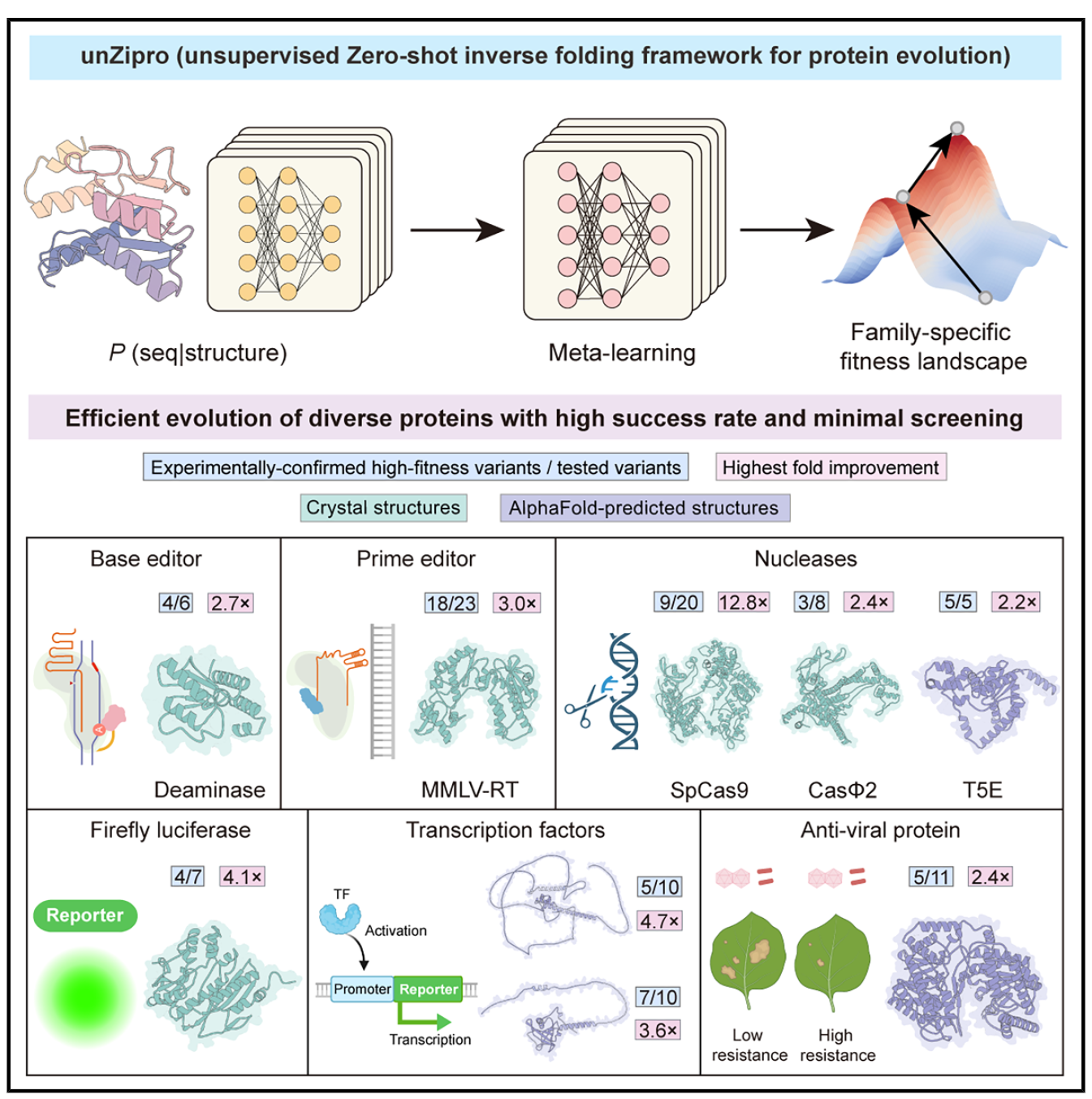
On September 24, 2026, ZLab, together with the teams of Prof. Xiang Ji, Researcher Daowen Wang, and Prof. Jiangning Song at Monash University, published “Simplifying in silico protein evolution with minimal screening by unZipro” in Molecular Cell.
The study introduces unZipro, an AI-driven strategy for protein-directed evolution. The method pretrains a graph neural network on 24,501 non-redundant protein structures and combines it with meta-learning to capture protein-family-specific sequence–structure constraints. Across 217 deep mutational scanning experiments covering 186 proteins and approximately 2.46 million mutations in the ProteinGym dataset, unZipro improved the prediction performance of pretrained models by 12.4%. Compared with nine representative methods, including ProteinMPNN, ESM-IF1, AiCE, EVOLVEpro, and MapDiff, unZipro delivered stronger mutation-effect prediction and high-fitness variant identification while retaining high computational efficiency.
Figure 1|Overview of the unZipro strategy and its applications
The team and its collaborators further applied unZipro to the rapid evolution of genome-editing tools and plant functional proteins. The study covered ABE, SpCas9, CasΦ2, and Prime Editor, as well as firefly luciferase, the rice transcription factors OsPHR2 and OsNAC3, and the barley antiviral protein HvMS1. Through an “AI prediction plus limited candidate validation” workflow, the researchers obtained high proportions of function-enhancing mutations across multiple systems. SpCas9 editing efficiency increased by up to 12.8-fold, while T5E-CasΦ2 improved by up to 27.9-fold. Among plant proteins, LUC activity reached 4.1-fold that of the wild type; representative OsPHR2 and OsNAC3 variants showed approximately 4.7-fold and 3.6-fold increases in transcriptional activation, respectively; and multiple HvMS1 variants with substantially enhanced antiviral activity were identified.
These results demonstrate that unZipro can achieve efficient directed evolution across protein types and species with a relatively small experimental screening scale, providing a new computational design route for genome-editing tool optimization and plant protein engineering.
unZipro offers a new path for protein-directed evolution to move from the traditional “large-scale mutagenesis and high-throughput screening” paradigm toward “computational prediction and limited experimental validation.” This is especially valuable for complex proteins and plant functional proteins that lack mature high-throughput screening systems or require costly experiments. By substantially narrowing the candidate space, the strategy can improve the discovery efficiency of beneficial mutations and lower the experimental barrier to protein engineering.
Looking ahead, the framework could be extended to combinatorial multi-site design and multi-objective optimization of activity, stability, and specificity. It may also help connect computational design, automated experimentation, and data feedback into a tighter iterative loop, providing more efficient and broadly applicable AI tools for genome editing, crop improvement, and protein engineering.